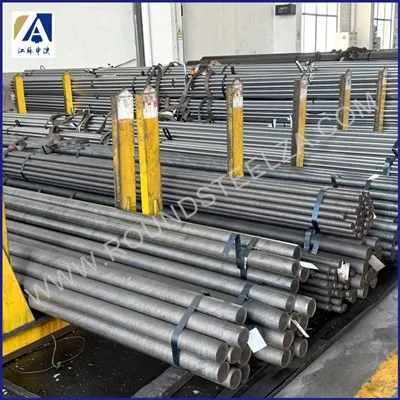
A Comprehensive Analysis of 45# Quenched And Tempered Steel Applications
Mar 18, 2026
In the diverse landscape of industrial manufacturing, few materials offer the versatility and economic efficiency of 45# Quenched And Tempered Steel. While high-alloy steels often grab the headlines for extreme applications, 45# steel (equivalent to C45, S45C, or AISI 1045) remains the workhorse of the industry.
Its unique combination of medium carbon content and the structural balance achieved through quenching and tempering makes it the ideal choice for components that face dynamic loads and wear. From the high-pressure environment of hydraulic systems to the intricate meshing of automotive gears, this steel grade delivers performance where it counts.
In this article, we analyze the specific applications of 45# Quenched And Tempered Steel and explain why it is the preferred material for high-strength mechanical components.
Hydraulic Industry Applications: The Backbone of Fluid Power
The hydraulic sector demands materials that can withstand immense pressure while maintaining a flawless surface. 45# Steel for Hydraulic Rods is the industry standard for manufacturing piston rods and cylinder barrels.
- Surface Hardness and Wear Resistance: Hydraulic rods are constantly sliding against seals under high pressure. 45# steel is often supplied in a quenched and tempered state (typically HB 220-250) and then subjected to high-frequency induction hardening. This process creates a hard outer shell (HRC 50+) that resists wear and scoring, while the tough core absorbs shock.
- Base for Plating: The dense microstructure of 45# Quenched And Tempered Steel provides an excellent substrate for hard chrome plating. A smooth, defect-free surface is crucial to prevent seal leakage and corrosion in harsh environments.
- Cost-Effective Strength: Compared to stainless steel, 45# steel offers comparable tensile strength at a fraction of the cost, making it the economical choice for mass-produced hydraulic equipment like excavators and forklifts.
Mechanical Manufacturing and Automotive Parts
In the automotive and general machinery sectors, components must endure cyclic loading and friction. 45# Steel for Gears and shafts is favored for its ability to be machined easily in the annealed state and then hardened to meet specific performance requirements.
- Gears and Sprockets: For gears that do not require the extreme case depth of carburizing steels (like 20CrMnTi), 45# steel is perfect. It offers good tooth strength and wear resistance. The "soft" core allows for some flexibility under shock loads, preventing brittle fracture.
- Automotive Axles and Spindles: The comprehensive mechanical properties of 45# steel-specifically its high yield strength (≥355 MPa) and good elongation-make it suitable for safety-critical parts like steering knuckles and transmission shafts.
- Machinability: One of the key 45# steel machining tips is to perform rough machining in the normalized state and finish after heat treatment. This ensures tight tolerances and a superior surface finish, essential for precision automotive assemblies.
Material Selection and Processing Tips
To maximize the potential of 45# Quenched And Tempered Steel, engineers should consider the following processing roadmap:
| Application | Recommended Treatment | Key Benefit |
|---|---|---|
| Hydraulic Rods | Quench & Temper + Induction Hardening + Chrome Plating | Maximum surface hardness (HRC 55) with tough core. |
| Gears | Quench & Temper + Nitriding | Good wear resistance with minimal distortion. |
| Structural Shafts | Normalizing or Quench & Temper | Good balance of strength and machinability. |
Pro Tip: When designing with 45# steel, remember that its hardenability is lower than alloy steels. For large cross-sections (>60mm), the core hardness may not be uniform. In such cases, consider using 42CrMo or limiting the section thickness.
Conclusion
45# Quenched And Tempered Steel is more than just a commodity material; it is a strategic choice for engineers seeking a balance of performance and cost. Whether you are manufacturing the robust piston rods that lift heavy machinery or the precision gears that drive automotive transmissions, 45# steel provides the reliability and strength required for modern engineering.